← The My First... series
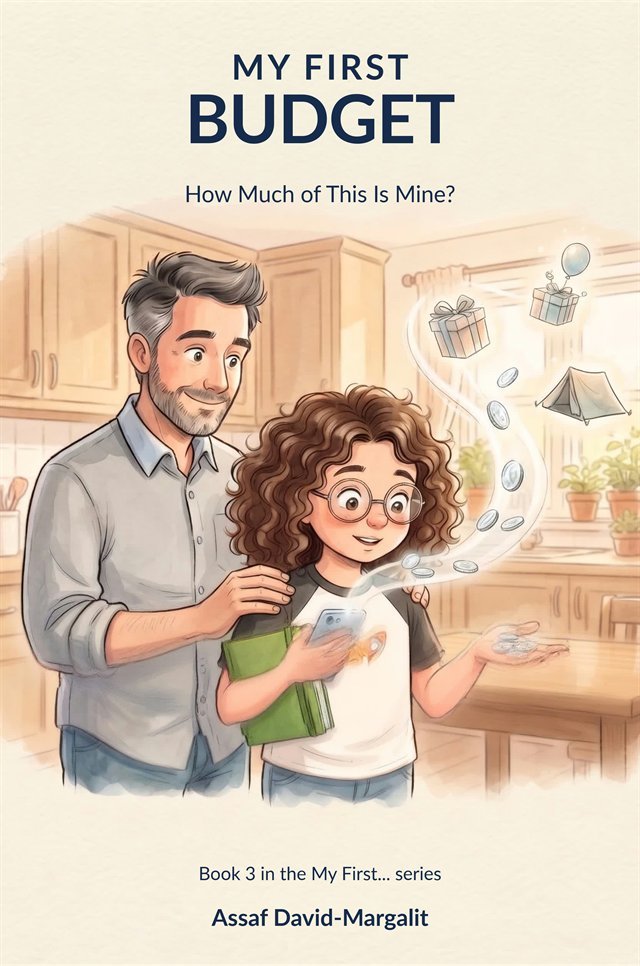
Cover of My First Budget: How Much of This Is Mine? by Assaf David-Margalit

Case #3: the $31 that was mostly promised

My First Budget

How Much of This Is Mine?

Emma has $31 and nothing waiting for it. It is the richest she has ever felt. Only $5 of it is hers.

A money story for ages 9 to 13. Kids see a balance on a screen long before anyone explains how much of it is really theirs.

Book 3 of the My First... series · Ages 9–13 (grades 4–8) · Paperback, 86 pages · ISBN 979-8166686909 · October 2026

A good gift for a birthday, the holidays, or the day a child gets a first allowance or card.

The case

Emma comes home from Grandma Ruth's with $31 and nothing waiting for it. It is the richest she has ever felt. Only $5 of it is hers.

The rest was promised weeks ago, in small pieces, and then forgotten: $6 for a class gift, a really good birthday present for her best friend Maya, and $8 for a camp trip, each with a due date. Eight days later her balances say $18, and she owes $26. Nobody took anything. Nine small, reasonable purchases did it.

Her dad doesn't hand her the missing $8. He clears the kitchen table instead, gets a pencil and a calendar, and Emma learns to give every dollar a job before it has a chance to leave.

Chapters

  1. The Richest She Had Ever Felt
  2. Three Promises in One Week
  3. The $18 That Was Already Gone
  4. Give Every Dollar a Job
  5. $9 for Snacks?!
  6. The Calendar Is Part of the Budget
  7. Sleep On It
  8. Two Promises, Six Days Apart
  9. The Month That Went Wrong
  10. The Seventh Question

Every chapter ends with a short rhyme, a page from Emma's notebook, and puzzles and missions for a child and a grown-up. The book closes with a Final Challenge, a glossary, and a note for parents and teachers.

No real brands are named. All figures are examples, because wallets and bank accounts differ in what they let you do, and their rules change over time. Nothing in the book is financial advice.
What you'll learn

  • Why the number on the screen is not all yours, and what a balance can never know
  • What a promise really is: a bill you've already agreed to pay
  • How to give every dollar a job: Now, Soon and Later
  • Why small purchases are the ones that add up, and why a repeating payment deserves a “yes” or “no” once a year
  • How a calendar shows whether there will be enough on each due date
  • The one-night rule, and how to say no to a friend in three words
  • What to do when the plan goes wrong halfway through the month
  • Why a budget isn't about spending less, but about keeping your promises

Answer key

Every chapter ends with puzzles and missions. Most are real-world missions with no single right answer. The answers aren't printed in the book. Wherever a puzzle has a clear answer, you'll find it here, by chapter, one tap away.

Chapter 1Show answers

3. The screenshot test. Write down three things a bank balance cannot know about your money.

Answer: Any three things that aren't in the account at this second. For example: what you've promised to pay for, when each promise is due, money that's coming in later (like next Saturday's allowance), and which part you meant to keep for something. A balance is a screenshot: honest about right now and blind about everything else.

Chapter 2Show answers

3. The green pen. Emma committed $6 by writing her name on a sheet in June. Name two other ways a person can commit money without spending on the date of commitment.

Answer: Any promise to pay later counts. For example: telling a friend “I'll get you something really good” (like Emma did to Maya), checking the box on a sign-up form for a trip that's paid later, agreeing to split something and pay your half next week, or starting a free trial that turns into a payment.

Chapter 3Show answers

1. Add up Emma's nine. Without looking at her total, add the nine amounts that left her wallet yourself. Careful: two lines in that list are not money leaving. Did you get $18.00?

Answer: $5.00 + $2.00 + $1.50 + $2.00 + $1.00 + $0.50 + $3.00 + $1.50 + $1.50 = $18.00. The two lines to leave out are the $5 allowance from Dad, which came in, and the $4 transfer to savings, which only moved Emma's money from one of her places to another.

2. The small ones. Of Emma's $18, how much went on snacks? What fraction of the total is that? Why is that the dangerous part?

Answer: $9.00, which is half of $18. It's the dangerous part because each snack cost a dollar or two, too little to feel like a decision, so none of them felt like spending. Emma can remember only two of the six visits.

5. The order matters. In one sentence, explain the difference between “spending too much” and “spending before you know what is yours.”

Answer: For example: spending too much means spending more than you have, while spending before you know what is yours means spending money that was already promised, because you didn't do the subtraction first. Emma's problem was the second one.

Chapter 4Show answers

3. The crack. Think of something in your life that is promised but not yet paid. If you only had Now and Later, where would you put it, and what might happen to it before it is due?

Answer: Your example is your own, but the problem is the same for everyone. In Now, the promised money gets spent a little at a time before the due date arrives. In Later, it's treated as far away and can't be reached in time. Either way the promise falls through the crack, which is why the book adds Soon.

Chapter 5Show answers

4. Under-deciding. Explain the difference between overspending and under-deciding in your own words.

Answer: Overspending is spending more than you can afford. Under-deciding is letting purchases happen without ever really choosing them. Emma didn't overspend: the game add-on, the poster and the photo app were all choices she would make again. The $9 of snacks just happened.

Chapter 6Show answers

2. Find the tight date. In Emma's plan, which single date is the tightest? What would have happened if her allowance had been one day late?

Answer: August 15. The biggest promise, Maya's $12 present, is due on the same day the allowance arrives, and even then Emma has to move $2 from Later. If the allowance had come a day late, her wallet would have held only $5 that morning, so she would have had to move $7 from Later instead of $2. She could still have kept the promise, but only by moving the money on purpose, out loud, and writing it down.

3. Front-loading. In one sentence, explain the difference between spending too much and spending too early. Which one was Emma's problem?

Answer: Spending too much means spending more than the month gives you, while spending too early means spending at the start what the rest of the month still needs. Emma's problem was spending too early: she had $25 of free money for the whole month and spent $18 of it in the first eight days.

Chapter 8Show answers

2. What did it cost, and what did it save? List what Emma gave up between August 4 and August 21. Then, list the hard moments she avoided because she kept her promises.

Answer: Gave up: seventeen days with nothing spent on herself, meaning no snacks, no games, and the puzzle box left in the window on Kennedy Street. Avoided: buying Maya a smaller present, asking Dad for money, taking her name off the class-gift sheet, and telling her mother the trip was too expensive after saying she would pay for things herself. Which list you'd prefer is up to you.

Chapter 9Show answers

2. Prediction or vow? Can you explain the difference?

Answer: A vow is a promise you either keep or break. A prediction is a guess about what will happen, and a guess that turns out wrong is completely normal: you check it and make a better one. A budget is a prediction. The promises you make to other people, with due dates, are not guesses: keep the promises, guess the rest.

Chapter 10Show answers

2. All seven. Write out all seven questions in your own handwriting, on one page.

Answer: 1. Where is it really kept? 2. How did it get in? 3. What exactly happened, and when did it actually happen? 4. Who else can see it? 5. What could go wrong, and how fast could I stop it? 6. Can you explain this line to me, please? 7. How much of the money in my accounts is actually mine?

3. Teach it. If you can explain Soon in one sentence and they understand it, you have it.

Answer: For example: Soon is money that's already promised to something with a due date, so it's sitting in your account but it isn't yours to spend.

The Final Challenge

find out how much is yours

The book ends with a mission of about 15 minutes, for a child and a grown-up sitting down together:

  1. Write down every promise. Everything you've said you will pay for, chip in on, or buy for somebody. Go back three months, and put a number and a due date on each one. This is the part everybody skips, and it's the part that does the work.
  2. Do the subtraction. All your money, minus all your promises. Write down what's left.
  3. Give it three jobs. Now, Soon, Later. Three pages or three lines, and every dollar on one of them.
  4. Put it on a calendar. Mark every date money comes in and every due date for money going out over the next month. Run the total down the side and find the tightest day.

Most people who do this for the first time find at least one promise they had forgotten. Then, on the first of next month, sit down for five minutes and do it again.

Words worth knowing

Balance
How much money is there right now. Always honest, but almost always incomplete.
Budget
A plan that gives every dollar a job before it is spent. It is a way of finding out which money is free.
Free money
Money that no job is claiming. The only money you actually get to decide about, today.
Front-loading
Spending most of a month's free money in the first few days of it. It is different from overspending, and much more common.
Later
The third job. Money for something far off, or not decided yet. The right place to take from when a promise needs covering, as long as you say so out loud.
Now
The first job. Money for this week, which you are supposed to spend. Spending it means the plan is working.
Prediction
What a budget actually is: a guess about what the month will do. It is not a vow.
Recurring payment (like a subscription)
A payment that happens again and again, on its own, until somebody stops it. It is only dangerous when you stop noticing it and it stops being a decision.
Repeating transfer (standing instruction)
An instruction to move money on a schedule. It does not know when its job is finished, so somebody has to tell it.
Soon
The second job, and the one most systems leave out. Money already promised to something with a due date.
Spoken-for money (committed money)
Money that is in your account but already promised to something. It looks exactly like free money.
Under-deciding
Letting small purchases happen without ever really choosing them. Usually where the money actually went.

Ask the author

Parents, teachers and readers are welcome to ask a question about the book. Kids under 13, please ask with a grown-up.

Published only once answered. Emails are never shown or shared.

Questions & answers

We use Spend, Save and Share jars at home. Why does the book use Now, Soon and Later instead?

It's the main place where the book departs from the usual advice, and I did it on purpose. The classic three jars have no place for a promise. Money committed to a class gift or a friend's birthday is neither spending nor savings, so it falls through the gap and gets spent. That's exactly what happens to Emma's $6 for Mrs. Lane's present all summer.

In practice, that gap is where a great deal of a child's money trouble happens, and Soon is the category that catches it. Chapter 4 makes the case in a child's own terms. If your family wants a giving or sharing category as well, it works perfectly well as a fourth page, and nothing in the method changes.

— Assaf David-Margalit

Ch. 4 · Give Every Dollar a Job

Emma is $8 short. Why doesn't her dad just give her the money?

Because the rescue is the dangerous version. Emma is $8 short on August 4, and no adult hands her the $8. Her father asks good questions and she does the arithmetic.

Chapter 8 walks through what would have happened otherwise. Nothing terrible: somebody covers it, with a short talk about being more careful, and Maya gets a smaller present. That's the point. Nothing bad visibly happens, and the child simply learns that promises are soft, one small rescue at a time. That passage is written as much for the adult reading over a shoulder as for the child.

— Assaf David-Margalit

Ch. 4 · Give Every Dollar a JobCh. 8 · Two Promises, Six Days Apart

My child spends money on small things without thinking. Will the book tell them that's wrong?

No, and that matters. Emma's $18 goes on a game add-on, half of a poster, an app she uses, and six snacks she can barely remember. Three of the four survive her own review.

The book's diagnosis is “under-deciding” rather than overspending: small purchases don't hurt, so they never feel like decisions, and they add up. The fix is the order of operations, not restraint: do the subtraction first, then spend the free part on purpose. A book that tells a ten-year-old their snacks were bad gets put down.

— Assaf David-Margalit

Ch. 3 · The $18 That Was Already GoneCh. 5 · $9 for Snacks?!

What happens when my child makes a budget and goes over it?

The book goes wrong on purpose. In September, Emma is $3 over at the halfway mark, and the book treats that as the normal operation of a prediction rather than a failed test. A budget is a guess about what the month will do, and guesses are often wrong.

The useful question isn't “Did I stick to it?” but “What did the month tell me, and what's my next guess?” The one thing that isn't a guess is a promise to someone else: keep the promises, guess the rest. If a child finishes the book believing a budget is something you can fail, it hasn't done its job.

— Assaf David-Margalit

Ch. 9 · The Month That Went Wrong

Case #1My First Digital Wallet: Where Is My Money?Emma turns 10 and gets a digital wallet. Then $6.75 vanishes.
On : Paperback Kindle