← The My First... series
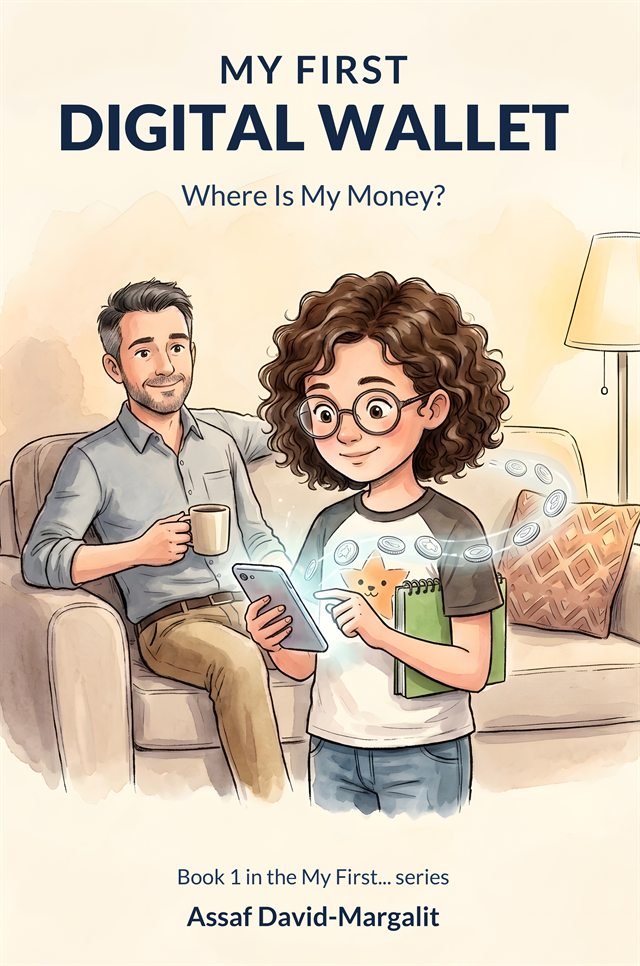
Cover of My First Digital Wallet: Where Is My Money? by Assaf David-Margalit

Case #1: the missing $6.75

My First Digital Wallet

Where Is My Money?

A birthday present with no corners. A wallet that holds no money. And $6.75 that walks out the door.

A money mystery for ages 9 to 13. Kids get payment apps long before anyone explains where the money actually is.

Book 1 of the My First... series · Ages 9–13 (grades 4–8) · Paperback, 92 pages · ISBN 979-8176323375 · October 2026

A good gift for a birthday, the holidays, or the day a child gets a first card or payment app.

The case

Emma turns 10 and gets a digital wallet. The app says $0.00. Three minutes later it says $25.00, sent by a grandmother 400 miles away, and Emma is left with a question nobody can answer quickly: where is my money, right now?

Her dad hands her a green notebook and tells her to write down the questions she can't answer yet. That notebook is about to get a lot of use.

Days later, $6.75 disappears. There's a company name she has never heard of, a date that makes no sense, and five suspects. Emma works through them one by one for three weeks, and the answer had been sitting in plain sight the whole time, on a screen she had opened sixteen times without once pressing it.

Nothing is hidden from the reader. Every clue arrives on the same page Emma gets it.

Chapters

  1. The Present With No Corners
  2. The Window and the Yard
  3. Faster Than a Blink
  4. The Charge Nobody Made
  5. The Guard Dog and the Secret Handshake
  6. The Message That Tried to Rush Her
  7. Training Wheels
  8. Cash Has One Superpower
  9. Case Closed
  10. Money Keeps Changing Its Clothes

Every chapter ends with the same three things: a short rhyme that makes the lesson stick, Emma's own notebook recap, and puzzles and missions to work through with a grown-up. The book closes with a Final Challenge, a glossary, and a note for parents and teachers. The answer key for the puzzles is here on the website.

No real brands appear anywhere. Every figure is an example, because wallet rules, limits and fees differ between products and change over time. Nothing in the book is financial advice.

What you'll learn

  • What money is, and why a digital wallet doesn't actually hold it
  • Where the money is really kept, and the three roads it takes to get in
  • What happens in the one second a phone taps a card reader: four questions, three parties, one answer
  • How to read a transaction history, and why the date on screen is often not the day it happened
  • How a “free trial” can quietly turn into a monthly payment
  • Why nobody ever has a good reason to ask for a PIN
  • How to spot a scam message by its three ingredients: fear, a deadline, and one link
  • What to do in the first minutes after a phone goes missing
  • Spending limits and fees, and why they're there to help
  • Cash and digital money compared honestly, including what cash still does better
  • The four-minute weekly habit at the heart of the book

Answer key

Every chapter ends with puzzles and missions. The answers aren't printed in the book. Wherever a puzzle has one right answer, you'll find it here, by chapter, one tap away.

Chapter 1Show answers

True or false: a twenty-dollar bill is worth twenty dollars because the paper it is printed on is worth twenty dollars. Explain your answer in one sentence.

Answer: False. A twenty-dollar bill is worth twenty dollars because enough people agree to accept it as twenty dollars. The paper is worth almost nothing on its own.

Chapter 2Show answers

Emma's wallet says $40.00, and she wants something that costs $52.00. Name three things that could happen next, and one thing that definitely cannot happen no matter what.

Answer: The three things that could happen: she adds money, she chooses something cheaper, she waits. The thing that cannot happen: the wallet invents the missing $12.00. A doorway cannot make money.

A wallet starts at $0.00. A grandparent sends $18.00. An allowance of $4.00 arrives twice. A parent tops it up with $7.50 from a card. What does the wallet say now? Which road brought the most money?

Answer: $0 + $18.00 + $4.00 + $4.00 + $7.50 = $33.50. The grandparent's $18.00 was the largest single amount.

Chapter 3Show answers

A wallet holds $12.00. Four payments arrive in this order: $4.00, $6.00, $5.00, $1.50. Which ones get approved and which get refused? What is the balance at the end?

Answer: $12.00 - $4.00 = $8.00 (approved). $8.00 - $6.00 = $2.00 (approved). $5.00 is refused, because $2.00 is not enough. $2.00 - $1.50 = $0.50 (approved). Final balance: $0.50.

Without looking back at the page, write down the four questions that get asked during a tap. Then check. How many did you get?

Answer: Is it really you? Is there enough money? Does anything look wrong? Do we all agree on the amount?

Chapter 4Show answers

Look at Emma's history table again: how many lines brought money in? How many took money out? Which single line is the largest? Which line is the oldest?

Answer: Three lines brought money in and three took money out. The largest line overall is the $25.00 from Grandma Ruth; the largest payment out is the $6.75. The oldest line is Saturday, September 27.

Cover the table with your hand. Now name the four pieces of information in a record line. Uncover and check.

Answer: Date, description, amount, status.

A wallet starts empty. It receives $30.00, then $12.50. It spends $8.25, then $4.10, then $16.00. What is the balance?

Answer: In: $30.00 + $12.50 = $42.50. Out: $8.25 + $4.10 + $16.00 = $28.35. Balance: $14.15.

You have exactly the same information Emma has. Is there anything in that table you would want to ask about, that Emma did not ask about?

Answer: The line most people should have asked about is PIXEL PONY PLUS, $1.99. Emma did not ask about it, which cost her $1.99 a month until October 26.
Chapter 5Show answers

Here are four reasons somebody might give for asking for your PIN. Which one is a good reason? I work for your bank. It's an emergency. I'm your best friend. I need to fix your account.

Answer: None of them. It is a trick question, and that is the lesson: there is no good reason, so you never have to judge whether the reason is good. Anybody asking is answered the same way.

Chapter 6Show answers

Emma used a date to rule out a suspect. Write down why a message received on October 14th cannot explain money that had been taken on October 2nd.

Answer: Money that left the account on October 2 cannot have been caused by a message that arrived on October 14, because a cause has to come before its effect. Dates rule suspects in and out.

Chapter 7Show answers

Sending $40.00 instantly costs a 1% fee. How much comes out of your wallet? How much arrives? How much would you save by waiting a day?

Answer: 1% of $40.00 is $0.40. Your wallet pays $40.40, the other person receives $40.00, and waiting one day would save you $0.40.

Chapter 9Show answers

A subscription costs $4.99 a month. How much is that in a year? In three years? How long would you have to keep it before it cost more than a $60 pair of headphones?

Answer: $4.99 x 12 = $59.88 a year, and $179.64 over three years. It passes the price of $60 headphones after 13 months.

The Final Challenge

Emma's Sunday check

The book ends with one mission to do with a grown-up and a real digital wallet or account. Open the history and read it top to bottom. Press every line, including the boring ones, and ask of each: did I mean to do that? Then find every payment that will happen again next month without anyone pressing anything, add them up, and multiply by twelve.

It takes four minutes, and nearly everybody who does it for the first time finds something.

Words worth knowing

Balance
How much money is in an account right now.
Bank account
The place money is actually kept. The yard, not the window.
Digital wallet
An app that lets you pay with money kept somewhere else, or receive it.
Fee
A small charge for a particular service, usually a fast one. Nearly always written in small grey letters.
Freeze
Switching a wallet off instantly so nothing can be paid from it, usually from somebody else's device.
History
The written record of everything a wallet or account has done. The most useful and least read screen in any app.
Pending
The payment has been promised, but the money hasn't finished moving.
PIN or passcode
A secret number that belongs to exactly one person or one purpose. Sharing it doesn't copy it. It defeats it.
Recurring payment (subscription)
A payment that happens again and again, on its own, until somebody stops it.
Trick message (phishing)
A message built out of fear, a clock and a single door, designed to make you move before you think.

Ask the author

Parents, teachers and readers are welcome to ask a question about the book. Kids under 13, please ask with a grown-up.

Published only once answered. Emails are never shown or shared.

Questions & answers

My child is ten and keeps asking for a payment app. Is that too young? And if I say yes, how much control should I keep?

The book doesn't argue for any particular age. It argues for a particular setup. In Chapter 7, “Training Wheels,” Emma's dad sets a daily limit, and he explains it this way: a limit isn't a guess about how sensible your child is, it's a guess about how bad a bad day can get.

On most youth wallets a parent can see what was spent, approve anything above the limit, and freeze everything instantly. The book frames that as a co-pilot, not a guard, and Chapter 4 and the note for parents explain why it matters: a child who sees your oversight as a second pair of eyes brings you the frightening screen, and a child who sees it as surveillance hides it. Let the limit move when your child asks and can explain why, the way Emma's does.

— Assaf David-Margalit

Ch. 7 · Training WheelsCh. 4 · The Charge Nobody Made

My son is convinced the money is “inside the phone.” How do I explain where it actually is?

Emma's best friend Maya thinks the same thing: “It's in the chip.” Chapter 2, “The Window and the Yard,” answers it with the picture I find works best. The app is a window and the bank account is the yard. You can see everything out there and move things around from your room, but the yard has never once been inside your bedroom.

The other half of the answer is that a wallet can't create money. It's a doorway, and money only reaches it by one of three roads: a linked bank account, a linked card, or someone sending it. Chapter 1 sums it up in one line: a digital wallet doesn't hold money, it holds permission.

— Assaf David-Margalit

Ch. 2 · The Window and the YardCh. 1 · The Present With No Corners

What actually happens when you tap a phone to pay? My daughter asks, and I realized I don't know.

Most adults don't, which is why Chapter 3, “Faster Than a Blink,” exists. A tap is a conversation between three parties, the wallet, the bank and the store, and four questions get answered in under a second: is it really you, is there enough money, does anything look wrong, and does everyone agree on the amount.

The detail worth teaching is that the “yes” is instant, but the money is not. It settles later, sometimes days later. That's why a payment can appear in the history under a different date from the day it happened, and it turns out to matter a great deal in Emma's case.

— Assaf David-Margalit

Ch. 3 · Faster Than a Blink

How do I teach my kids to recognize scam texts without making them afraid of every message they get?

Chapter 6, “The Message That Tried to Rush Her,” gives kids a recipe rather than a fear: nearly every trick message is built from fear, a clock, and one single door (a link, a number, an app). When all three show up together, it's a trap.

But the rule I care about most is simpler, because even careful adults can't always tell real from fake: never use the door they gave you. Close the message, open the app the way you always do, or call the number on the back of your card. If the problem is real, it will be waiting there. That rule works even when you can't tell, which is the whole point of it.

— Assaf David-Margalit

Ch. 6 · The Message That Tried to Rush Her

My daughter shares her phone passcode with her best friend. They trust each other completely. Is that really a problem?

Emma faces exactly this in Chapter 5, “The Guard Dog and the Secret Handshake.” Maya asks for the code, and Emma says no. Not because she thinks Maya would take anything, but because if something strange ever happened, she'd have to wonder, and she doesn't want to have to wonder about her best friend.

That's the reasoning I'd give a child. A code that lives in two heads isn't a lock anymore, and sharing a PIN doesn't copy it, it defeats it. It protects the friendship as much as the money.

— Assaf David-Margalit

Ch. 5 · The Guard Dog and the Secret Handshake

What should a child do in the first few minutes after losing a phone with a wallet on it?

Tell a grown-up immediately. Don't search first, and don't wait to see if it turns up. Chapter 5 walks through Emma's lost phone minute by minute: three minutes after she notices, her dad has frozen the wallet from his own phone, and from that moment it's useless to anyone.

The only number that matters in a lost-phone story is the gap between “it's gone” and “it's frozen,” and the only thing that shortens it is telling someone right away. It's also worth knowing what Emma discovers: most lost phones aren't stolen, they're just lost.

— Assaf David-Margalit

Ch. 5 · The Guard Dog and the Secret Handshake

Why does a book about digital money spend a whole chapter on cash? Isn't cash on its way out?

Because cash still does things a phone can't, and kids should know both tools honestly. In Chapter 8, “Cash Has One Superpower,” the card reader at the school fair dies and a shoebox of bills keeps the line moving. Cash works with no signal and no battery, and you feel it leaving your hand, which most people find makes them spend less.

But when Emma loses a five-dollar bill the same afternoon, there's nothing to check: no record, no name, no time. Chapter 10 widens the lens: money keeps changing its clothes, from shells to coins to apps, and the five questions at the end of the book work on all of them.

— Assaf David-Margalit

Ch. 8 · Cash Has One SuperpowerCh. 10 · Money Keeps Changing Its Clothes

Play the book

Two free games turn what Emma learns into practice. They’re made for a young detective and a co-pilot (a parent, a grandparent, or a big brother or sister) to play side by side, and they work best after reading the chapters they’re based on. Neither game gives away how Emma’s case ends.

Case File #1 · about 5 minutes

Spot the Trick

Practices chapters 5 and 6: The Guard Dog and the Secret Handshake and The Message That Tried to Rush Her

  • Find the scary words, the rush and the scammer’s door in a message
  • Never use the door a message gives you
  • Every excuse for asking for a PIN is the wrong one
  • A lost phone: tell someone right away
Play Spot the Trick →
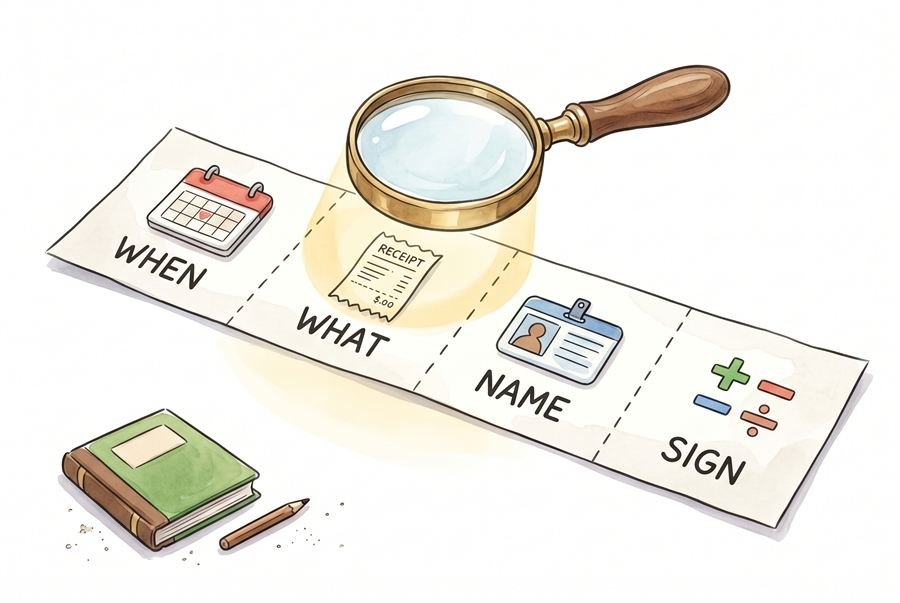
A magnifying glass over a history line: when, what, name and sign

Case File #2 · about 6 minutes

The Sunday Check

Practices chapters 4, 7 and 9: The Charge Nobody Made, Training Wheels and Case Closed

  • Read every line of a wallet history, like Emma does
  • Check every suspect, one by one
  • Press the line to see the whole story
  • Find the payments that hum, and what they cost in a year
Play The Sunday Check →

The games practice the method. The book is the mystery: Emma’s own case, $6.75 that walks out the door, five suspects, and every clue on the page.

My First Digital Wallet: Where Is My Money? cover

Available now on

Get My First Digital Wallet

The full case: a birthday wallet, $6.75 that walks out the door, five suspects, and every clue on the page. With rhymes, Emma’s notebook, and puzzles and missions to do together.

A great gift for a birthday, the holidays, or a first phone or payment app.

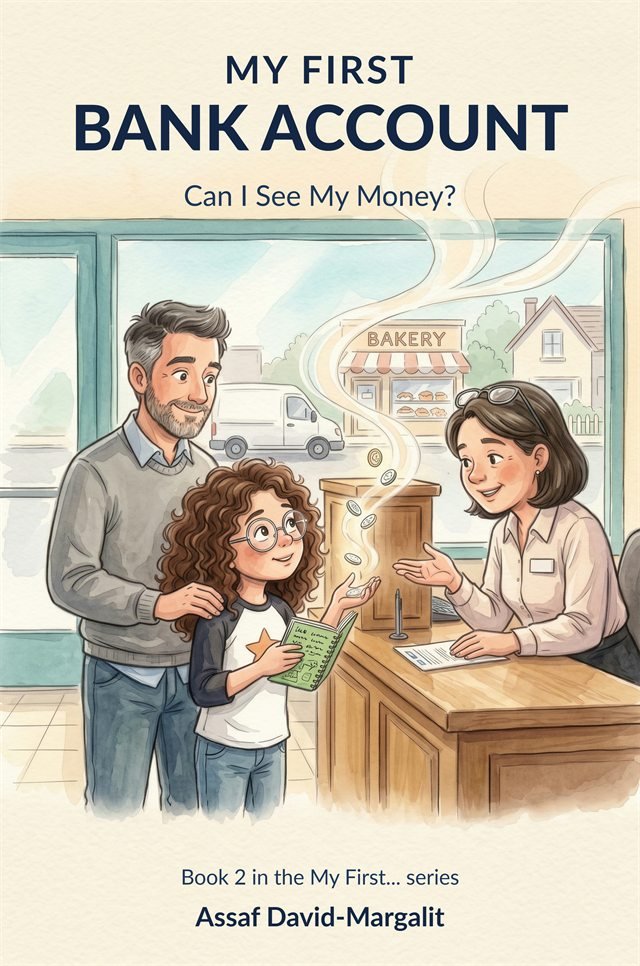
Case #2My First Bank Account: Can I See My Money?Emma walks into a bank and asks to see her money. Nobody can show it to her.
On : Paperback Kindle