← The My First... series
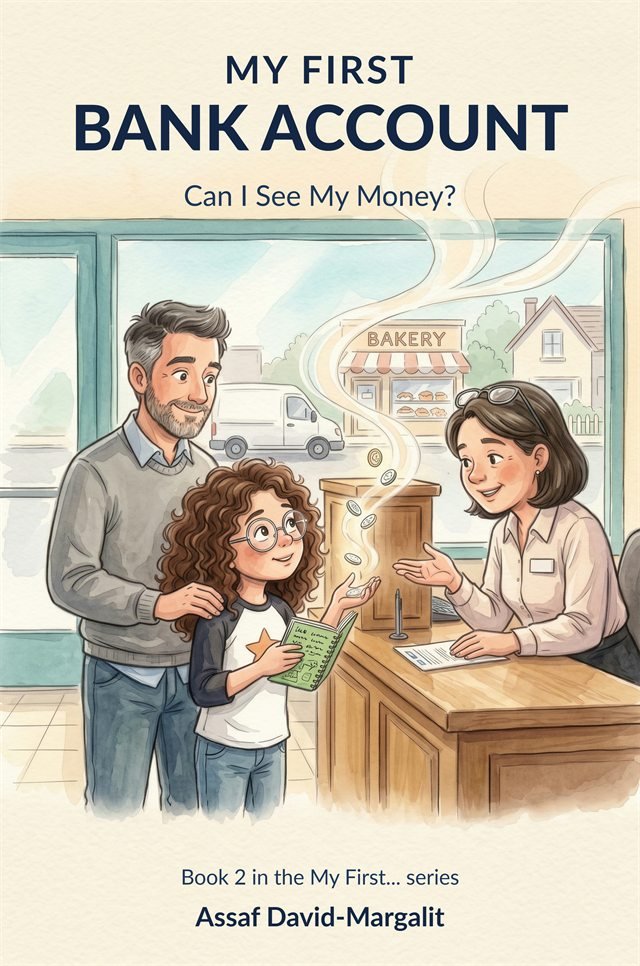
Cover of My First Bank Account: Can I See My Money? by Assaf David-Margalit

Case #2: the money nobody can show her

My First Bank Account

Can I See My Money?

“None of that money is yours,” the teller tells her. “And all of it is yours.”

A money mystery for ages 9 to 13. Kids are told to “put it in the bank” long before anyone explains where the money actually goes.

Book 2 of the My First... series · Ages 9–13 (grades 4–8) · Paperback, 98 pages · ISBN 979-8178521687 · October 2026

A good gift for a birthday, the holidays, or the day a child opens a first bank account.

The case

Emma has $61 in a shoebox and needs $96 for a train ticket to visit Grandma Ruth this summer. So she walks into a bank and asks to see her money. Nobody can show it to her.

Once Emma opens her own account, her first statement shows 4 cents of interest and a $3 monthly fee. She doesn't understand the fee, and she's too embarrassed to ask. Then a calm, friendly man calls her on the phone. He knows her name, her branch, and the month she opened her account. And he tells her not to involve anybody.

The fee could have been fixed in about three minutes with one short question. Getting Emma to ask it takes the whole book.

Chapters

  1. The Boy Who Finally Paid
  2. I Want to See My Money
  3. Two Rooms and a Signature
  4. The $4 Maya Laughed At
  5. Two Numbers at the Bottom
  6. 4 Cents and What It Means
  7. The Van Outside the Window
  8. But What If Everybody Came at Once
  9. The Voice That Knew Her Name
  10. Eight Words

Every chapter ends with a short rhyme, a page from Emma's notebook, and puzzles and missions for a child and a grown-up. The book closes with a Final Challenge, a glossary, and a note for parents and teachers.

No real banks are named. All numbers are examples, because rules, rates and fees vary between banks and countries and change over time. Nothing in the book is financial advice.
What you'll learn

  • What a bank really does with your money, and why there's no box anywhere with your name on it
  • Checking vs. savings, and why it's fine to share an account number but never a password
  • How saving $4 a week adds up, and how a repeating transfer can work for you or against you
  • How to read a bank statement and check that it adds up
  • What interest is, and why a bank pays you anything at all
  • What a bank run is, and what protects people's deposits
  • How phone scams work, including the “safe account” trick, and the one request that should make any child hang up
  • The question that costs nothing to ask and can bring money back

Answer key

Every chapter ends with puzzles and missions. Most are real-world missions with no single right answer. The answers aren't printed in the book. Wherever a puzzle has a clear answer, you'll find it here, by chapter, one tap away.

Chapter 1Show answers

3. Plate or kitchen. For each of these, decide whether it belongs on the plate or in the kitchen: money for lunch this week, birthday money you want to keep, the cost of a bus fare, savings for something in six months.

Answer: Plate (spending soon): lunch money for this week, the bus fare. Kitchen (keeping): birthday money you want to keep, savings for something in six months.

Chapter 2Show answers

1. The milk problem. A cafe serves about 60 customers a day and about half of them want milk. How much should it keep at the counter: enough for 30, enough for 60, or enough for 600?

Answer: Enough for about 30, plus a little extra in case it isn't a normal day. Not 60, because only about half the customers want milk, and certainly not 600. A bank keeps cash the same way: enough for a normal day, plus a margin.

2. Both at once. Explain how “none of that money is yours” and “all of that money is yours” can both be true.

Answer: None of the bills in the drawer or the vault belong to you, because all deposits go into one shared pile and the bills don't remember who brought them. But the bank owes you every dollar you put in, and will pay you from whatever bills it has when you ask. (Chapter 7 explains it fully.)

3. What a record is worth. Box A contains $50 in cash and no label. Box B is empty, but comes with a signed, witnessed, legally binding note from a bank saying it owes you $50. Which would you rather have, and why?

Answer: Either answer can be argued. The book's answer is Box B: the promise is written down, exact, backed by law and can't burn, be stolen or be forgotten in a coat. Box A has no label, so nothing proves it's yours.

Chapter 3Show answers

1. Hallway or quiet room. Sort these into checking or savings: money for this week's lunches, money for a trip in August, the money a job pays in every month, money set aside for a bike. Then explain what would go wrong if you put the August money in the hallway.

Answer: Checking (the hallway): this week's lunches, the monthly pay from a job. Savings (the quiet room): the August trip, the bike. In the hallway, the August money mixes with money passing through, gets spent a little at a time without anyone noticing, and earns nothing while it waits.

2. Address or key. Decide which each of these is: your house number, your front door key, your bank account number, your banking password, your name, your banking app PIN code. Three of these can be shouted across a playground safely. Which three?

Answer: Addresses: house number, bank account number, name. Those are the three you can shout. Keys: front door key, banking password, PIN. An address tells people where something goes. A key lets them in.

3. You have $48.00 and you need $110.00 for something. You can save $6.00 a week. How many weeks? Now do it again if you can only save $4.00 a week.

Answer: You need $110.00 - $48.00 = $62.00. At $6.00 a week: $62 ÷ $6 = 10.33, so 11 weeks. At $4.00 a week: $62 ÷ $4 = 15.5, so 16 weeks. Saving $2 less a week adds 5 weeks.

5. The four things. What does a bank ask for when a young person opens an account? Compare it with Emma's four.

Answer: Emma's four: who she is (name, date of birth, identification number), where she lives (address, email, phone), proof of both (a document such as a passport or birth certificate, and something with the address on it), and a grown-up who signs.

Chapter 4Show answers

1. $4 a week. How much is that in a month? In a year? In five years?

Answer: About $16 a month (four Saturdays, like Emma's first month; a little more in a five-Saturday month). $4 × 52 weeks = $208 a year. $208 × 5 = $1,040 in five years.

3. Name the road. For each of these, name which of the three roads in or four roads out it uses: allowance handed over in coins, a phone bill paid on the same date every month, a birthday check from a grandparent, buying a drink with a card, moving money to a friend.

Answer: Allowance in coins: in, by hand. Phone bill every month: out, by standing instruction. Birthday check: in, by check. A drink paid by card: out, by card or digital wallet. Money to a friend: out, by transfer.

Chapter 5Show answers

1. A statement shows an opening balance of $120.00, deposits of $30.00 and $45.50, and withdrawals of $12.25, $60.00 and $8.75. What should the closing balance be? If the statement said $115.00, what would you do?

Answer: In: $120.00 + $30.00 + $45.50 = $195.50. Out: $12.25 + $60.00 + $8.75 = $81.00. Closing balance: $195.50 - $81.00 = $114.50. If the statement said $115.00, it doesn't add up by 50 cents: check your math once more, then ask the bank about it.

2. Emma earned $0.04 and paid $3.00. How many times more is the fee than the interest? What does she pay in a year, and what does she earn in a year?

Answer: $3.00 ÷ $0.04 = 75 times. In a year she pays $3.00 × 12 = $36.00 and earns about $0.04 × 12 = $0.48.

4. Emma needed to say eight words to fix this. What do you think they were?

Answer: “Can you explain this line to me, please?” (Emma finally says them in chapter 10.)

Chapter 6Show answers

1. Work out one year of interest at 1% on each of these: $50, $200, $1,000, $10,000. What does that tell you about who interest rates matter most to?

Answer: $0.50, $2.00, $10.00 and $100.00. The rate is the same, but the dollars grow with the amount, so interest rates matter most to people with a lot of money saved, or a lot borrowed.

2. Which way is the arrow? Say whether interest points towards you or away: money in your savings account, money you borrowed to buy a phone, a balance left unpaid on a credit card, a government bond, a loan from a friend with no interest.

Answer: Savings account: towards you. Money borrowed for a phone: away. Unpaid credit card balance: away. Government bond: towards you (you lent money to the government). A loan from a friend with no interest: no arrow at all, because no interest is paid.

3. In one sentence, explain why being paid interest is evidence that your money is being used.

Answer: Nobody pays rent on something nobody is using, so interest is the bank's receipt that your money has been lent out and put to work.

Chapter 7Show answers

1. Follow the chain: Emma, the bank, Mr. Alvarez, the van, the rent, back to Emma. Label each arrow with what travels along it.

Answer: Money goes one way: Emma to the bank, the bank to Mr. Alvarez, Mr. Alvarez to whoever sold the van. Promises go the other way: Mr. Alvarez promises to repay the bank, and the bank promises to repay Emma. Rent comes back along the chain: Mr. Alvarez pays the bank interest, and the bank pays Emma a small slice of it (her 4 cents).

2. Pile or promise. $200 in cash hidden in your house, or a written promise from a bank for $200 that you can't touch until tomorrow. Which is safer? Which is easier to spend today? Which would you rather have for a month?

Answer: Safer: the bank's promise. Easier to spend today: the cash. For a month: the promise, which is written down, can't burn or be stolen, and pays a little interest. The cash just sits there.

5. Why did Ms. Delgado correct Emma about the van? Write the corrected version in one sentence.

Answer: Emma said her $61 was in the van, but deposits go into one shared pile, so nobody can follow particular dollars to a particular loan. Corrected: “The bank lends out money from the pile my $61 went into, and what I own is the bank's promise to pay me $61.”

Chapter 8Show answers

1. Your branch has 800 customers. On a normal day, 40 of them come in and take out an average of $60 each. How much cash should you have in the morning? How much extra would you keep for an unusual day?

Answer: A normal day: 40 × $60 = $2,400. The extra is your choice; there's no single right number. Any sensible margin on top of $2,400 works if you can explain it, and remember a bank can also get more cash quickly from nearby banks.

4. Put these in order, from least safe to most safe: cash in a shoebox, cash in a home safe, money in a guaranteed bank account, money lent to a friend.

Answer: Least to most safe: money lent to a friend (no record, no rules, and it comes back when the coat remembers), cash in a shoebox, cash in a home safe, money in a guaranteed bank account (protected up to the limit where you live).

Chapter 9Show answers

1. Daniel knew four things about Emma. For each one, write down a way a stranger could have found it out or guessed it.

Answer: Her name: the school newsletter that goes out to 400 families. The branch: Bridge Street is the biggest of the town's three branches, so it's a good guess. The month: January is a normal month to open an account, and a scammer calling a hundred kids will be right often enough. Savings: a fifty-fifty guess, and if he'd been wrong, Emma would have corrected him.

2. Address or key, round two. Which could you safely read out over a phone, and which must you never: your name, your account number, your password, your date of birth, your branch, your PIN code, your home address?

Answer: Never: your password and your PIN. They're keys. Usually fine: your name, your account number and your branch. They're addresses. The two that people argue about are your date of birth and your home address: banks often use them to check who you are, and scammers collect them. Either way, if someone calls you, the safest move is to hang up and call the number on your card or statement.

5. Explain why “move your money to a safe account” can never be a genuine instruction.

Answer: There's no such thing as a safe account. Your account already is the safe account, and a real bank never needs you to move your money to protect it. Anyone who asks wants your money sent to them.

Chapter 10Show answers

1. Take any small monthly amount: $2, $3, $5. Work out what it costs in a year, in five years, and in ten.

Answer: $2 a month: $24 a year, $120 in five years, $240 in ten. $3 a month: $36, $180, $360. $5 a month: $60, $300, $600.

5. What do you think you'll be allowed to do with a bank account at twelve, at sixteen and at eighteen?

Answer: At Emma's bank: her own login at twelve, most restrictions off at sixteen, and the account in her name alone at eighteen. Real banks and countries differ, which is why the mission asks you to check a real bank's website.

The Final Challenge

make a statement add up

The book ends with a mission for a child and a grown-up with one real bank statement, on paper or on a screen:

  1. Make it add up. Find the opening and closing balance. Add every line in, subtract every line out, and check that it works. If it doesn't, you've found something.
  2. Find every fee. Every one, for a whole year if you can. Add them up, then multiply by 5, because that's what they'll cost by the time you're 5 years older.
  3. Ask about one line. Any line at all, in a branch or on the phone, using the number printed on the bank's statement and never one from a message: “Can you explain this line to me, please?”

Words worth knowing

Account number
The address of an account, so the banking system knows where a payment goes. Not a secret and not a key.
Balance
How much the bank owes you right now.
Bank run
What happens when a great many people ask for their money on the same day.
Checking account (current account)
The hallway. Built for money moving through, several times a week.
Deposit protection
A government-backed guarantee on money in a bank account, up to a limit, if the bank fails. The name, the limit and what it covers differ by country and change over time.
Interest
Rent on money, charged for time, written as a percentage per year. It points toward you when you save and away from you when you borrow.
Savings account
The “quiet room.” Built for money that is staying still, which is why it earns a little.
Service fee
A charge for having the account at all. Youth accounts usually have none, which is worth knowing before you open one.
Standing instruction (repeating transfer)
An order left with the bank to move money on a schedule without asking you first. It doesn't care which direction you point it.
Statement
A bank's report on one stretch of time: where you started, everything that happened, where you ended.

Ask the author

Parents, teachers and readers are welcome to ask a question about the book. Kids under 13, please ask with a grown-up.

Published only once answered. Emails are never shown or shared.

Questions & answers

Should a ten-year-old have their own bank account? And why does a parent have to sign?

In Chapter 3, “Two Rooms and a Signature,” Emma asks the same thing: “It's my money!” The answer is that an account is an agreement the law will enforce, and in most places a person under eighteen can't make that kind of promise alone. The rule is about everyone her age, not about her. Depending on the country and the bank, it may be a joint account, a custodial account, or a parent acting as guarantor.

Chapter 10 shows how the account grows up with the child. At Emma's bank she gets her own login at twelve, most restrictions come off at sixteen, and the account becomes hers alone at eighteen. Your bank's rules may differ, and finding out together is a good first conversation.

— Assaf David-Margalit

Ch. 3 · Two Rooms and a SignatureCh. 10 · Eight Words

Is it wise to tell children that banks lend out their savings? Won't that make them anxious?

I thought hard about this one. A book that says “the bank keeps your money safe in a vault” teaches something that isn't true and will have to be unlearned later. So Chapter 7, “The Van Outside the Window,” says it plainly: banks lend out deposits, which is why they can pay interest at all. What you own is the bank's written promise to pay you, and the chapter makes the case that a promise is safer than a pile.

Then Chapter 8 takes the obvious next question seriously: what if everybody wants their money at once? It explains the three defenses that make a bank run rare: banks keep enough for a normal day, they follow rules they don't get to choose, and in most countries deposits are guaranteed up to a limit. Kids tend to find that reassuring rather than scary, because the scary question gets an honest answer.

— Assaf David-Margalit

Ch. 7 · The Van Outside the WindowCh. 8 · But What If Everybody Came at Once

Savings interest is tiny. Why should a child bother with a savings account at all?

Emma has the same reaction to her first statement: four cents of interest. Chapter 6, “4 Cents and What It Means,” turns the question around: don't ask how much, ask why. Interest is rent on money, and nobody pays rent on something nobody is using. The four cents are a receipt proving her money is out there working.

The real reason to save, though, is in Chapter 4: a small repeating transfer of $4 a week, added to her shoebox money, is how Emma plans to reach a $96 train ticket. And Chapter 5 shows the other side of the statement. At small balances, a fee can easily be worth far more than the interest, which is why reading every line matters more than the rate.

— Assaf David-Margalit

Ch. 6 · 4 Cents and What It MeansCh. 4 · The $4 Maya Laughed At

How do I protect my child from phone scams? A text is one thing, but a friendly voice is much more convincing.

That's exactly the gap Chapter 9, “The Voice That Knew Her Name,” is about. The caller knows Emma's name, her branch, the month she opened her account and that it's a savings account, and that feels like proof. It isn't. The chapter shows how each fact could come from a school newsletter or a lucky guess.

The rules are simple. Anyone who tells a child not to involve a grown-up has just told them everything they need to know. Hang up and call the number printed on the card or statement, never the one the caller gives. And there is no such thing as a “safe account.” Your account already is the safe account.

— Assaf David-Margalit

Ch. 9 · The Voice That Knew Her Name

My child is too embarrassed to ask questions about money, even when something looks wrong. Does the book deal with that?

It's the heart of the book. In Chapter 5, “Two Numbers at the Bottom,” Emma spots a $3 monthly fee she doesn't understand, and she says nothing for five weeks, because asking would mean admitting to an expert that she doesn't understand her own money. Most adults know that feeling. It's the single most expensive habit in personal finance.

Chapter 10, “Eight Words,” is about the one question that fixes it. The Final Challenge then asks a child and a grown-up to ask about one real line on a real statement. Children learn this mostly by watching an adult ask without embarrassment, so the most useful thing you can do is go first.

— Assaf David-Margalit

Ch. 5 · Two Numbers at the BottomCh. 10 · Eight Words

Case #3My First Budget: How Much of This Is Mine?Emma has $31 and feels rich. Only $5 of it is hers.
On : Paperback Kindle