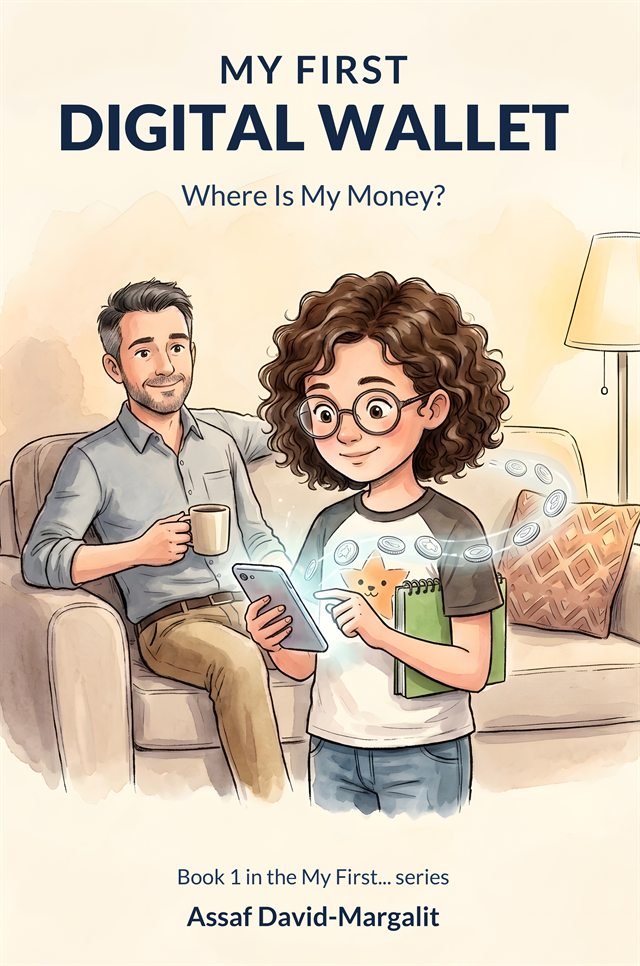
Emma turns 10 and gets a digital wallet. Then $6.75 vanishes. Five suspects, one green notebook, and every clue on the page. Kids learn where app money really lives, how a tap payment works, how free trials turn into monthly charges, and how to spot a scam text.
▶ Two free family games Details, available sample and answer key →The My First... series · Ages 9–13
Money mystery books for kids who just got their first real money tools
Ten-year-old Emma keeps running into money mysteries she didn't ask for. A birthday present that turns out to be a digital wallet. Dollars that vanish without a reason. A bank that can't show her the money she just put in. $31 that turns out to be mostly promised. Readers get every clue on the same page Emma does, so they can try to solve the case before she does.
Along the way they learn how money actually works: where it's kept, how payments move, how to read a statement, how to spot a scam, and how to plan. It's written by someone who works on digital money and payments regulation at a central bank.
Available now on
The books
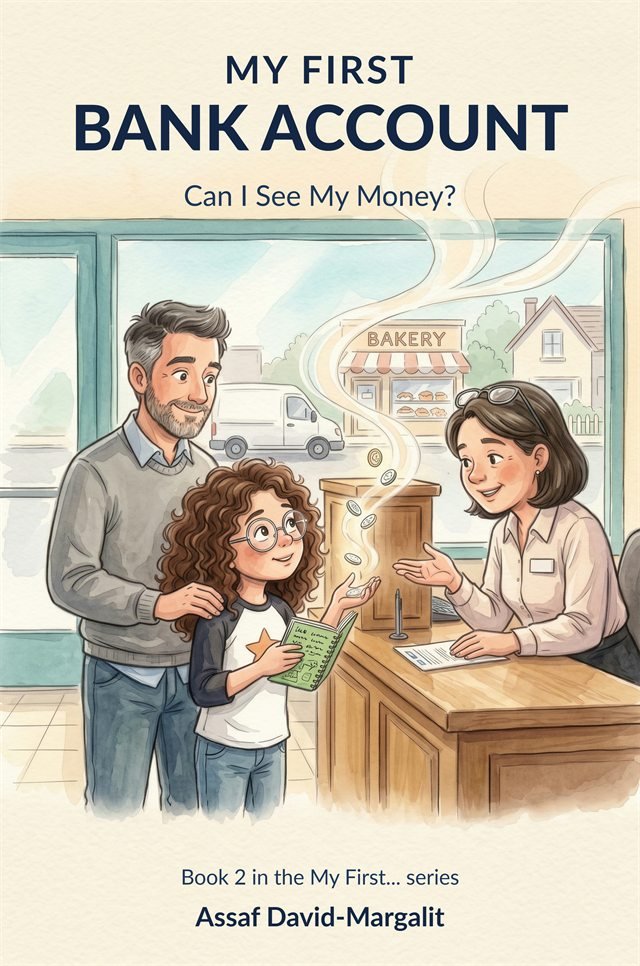
Emma needs $96 for a train ticket to Grandma's. She walks into a bank and asks to see her money. Nobody can show it to her. Kids learn what banks really do with deposits, checking vs. savings, interest, how to read a statement, and how phone scams work.
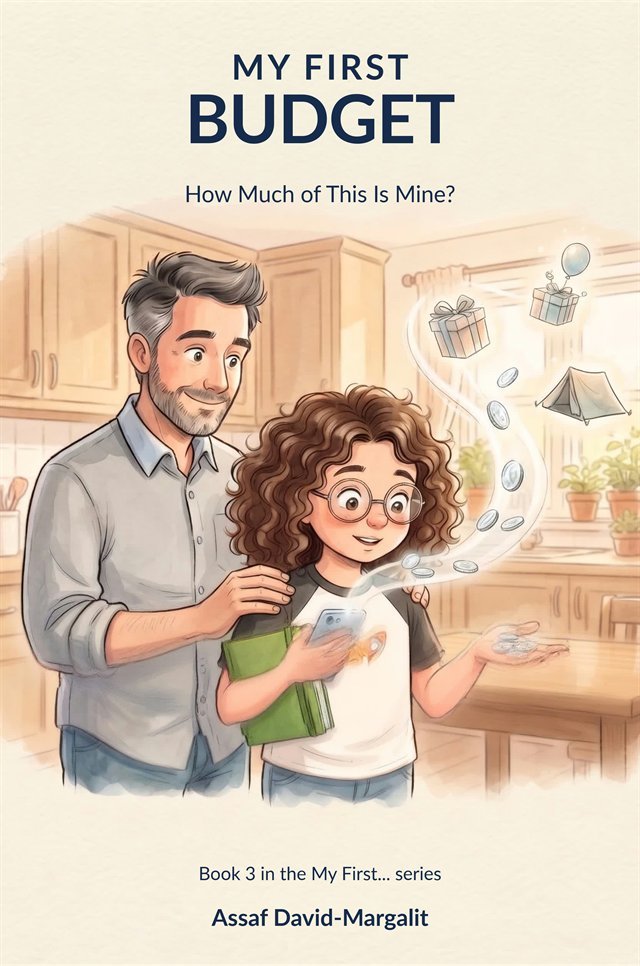
Details, available sample and answer key →Emma has $31 and feels rich. Only $5 of it is hers. The rest was promised weeks ago and forgotten. Kids learn why a balance isn't all theirs, how to give every dollar a job (Now, Soon and Later), why small buys add up, and how to say no to a friend in three words.
Details, available sample and answer key →Prefer Kindle? See the whole series on .
Why families and teachers use it
A story first, and real explanations inside it
A mystery kids want to solve
Every book is a case with suspects, clues and a twist. Nothing is hidden from the reader, so kids are reasoning alongside Emma instead of being lectured.
Explanations that hold up
Where app money is kept, what happens in a tap payment, what a bank does with deposits. The answers are simplified for kids, and they're still correct.
Made to read together
Each chapter ends with a short rhyme, Emma's notebook recap, and puzzles and missions for a child and a grown-up. Each book closes with a Final Challenge, a glossary and a note for parents and teachers.
Safety without fear
Scam texts, phone scams, PINs, lost phones. Kids learn the warning signs and what to do, and the books never try to scare them.
No brands, no advice
No real apps, banks or brands are named. All figures are examples, and nothing in the books is financial advice.
Habits that last
Book 1 builds a four-minute weekly habit: read every line. Book 2 adds one question that costs nothing to ask: “Can you explain this line to me, please?” Book 3 adds one to ask before spending: “How much of this is actually mine?”
Find the right book
What kids learn, and where
| Topic | Book |
|---|---|
| Where money in a payment app really lives, and why the wallet doesn't hold it | Digital Wallet |
| What happens in the one second a phone taps a card reader | Digital Wallet |
| Reading a transaction history, and why the date shown isn't always the day it happened | Digital Wallet |
| Free trials, subscriptions and recurring payments | Digital Wallet |
| PINs, scam texts and what to do if a phone goes missing | Digital Wallet |
| What a bank does with your money, and why there's no box with your name on it | Bank Account |
| Checking vs. savings, and saving toward a goal with a repeating transfer | Bank Account |
| Reading a bank statement, interest and fees | Bank Account |
| Bank runs and what protects people's deposits | Bank Account |
| Phone scams, including the “safe account” trick | Bank Account |
| Why the balance on a screen isn't all yours to spend | Budget |
| Giving every dollar a job: Now, Soon and Later | Budget |
| Small purchases that add up, and checking repeating payments once a year | Budget |
| Planning with a calendar so every promise is covered on its due date | Budget |
| Saying no to a friend in three words, and the one-night rule | Budget |
| What to do when the plan goes wrong halfway through the month | Budget |
More on using the books at home and in class: For parents and teachers.
Questions
Common questions
What age is the My First... series for?
Ages 9 to 13, roughly grades 4 to 8. The stories work for independent readers, and every chapter ends with puzzles and missions meant to be done with a grown-up.
Are the books fiction or nonfiction?
Both. Each book is a mystery story about a girl named Emma, and the explanations of how money works inside the story are real and accurate.
Do the books need to be read in order?
No. Each book stands alone. Books 2 and 3 each open with a short recap of what Emma learned in the earlier books.
Where can I buy them?
On Amazon, in Kindle and paperback. My First Digital Wallet (paperback), Kindle. My First Bank Account (paperback), Kindle. My First Budget (paperback), Kindle.
More answers on the parents and teachers page, and in our guide: More answers: 12 money lessons for ages 9–13.
New · Book 3
My First Budget
Emma has $31 and nothing waiting for it, and she's about to find out how much of it is really hers. Book 3 is out now in paperback and Kindle.


